What is the Model Context Protocol? A plain-English explainer for non-technical teams
The Model Context Protocol explained without jargon: what MCP is, why it exists, how an assistant uses it, what it can and cannot do, and what to ask before your team adopts it.
The Gihonix team · · 4 min read
Key takeaways
- MCP is an open standard that lets AI assistants connect to tools and data in one consistent way.
- Think of it as a universal adapter between assistants and your business systems.
- It does not make an assistant smarter; it gives it controlled access, so permissions and testing still matter.
The Model Context Protocol (MCP) is an open standard that lets AI assistants connect to outside tools and data, such as your files, database, shop or CRM, in one consistent way. Instead of building a separate custom connection for every assistant and every system, a business builds one MCP server and any compatible assistant can use it.
The official site, modelcontextprotocol.io, describes it as an open protocol, and its documentation compares it to a USB-C port for AI applications. That is a useful picture: one standard plug instead of many different ones.
Why does MCP exist?
An AI assistant on its own only knows what it was trained on plus whatever you paste into the chat. It cannot see your orders, your calendar or your price list. To be useful at work, it needs access to those things.
Before MCP, each connection was custom work. Connecting five assistants to ten systems could mean fifty separate integrations. MCP replaces that with a shared language between assistants and systems.
How does MCP work in simple terms?
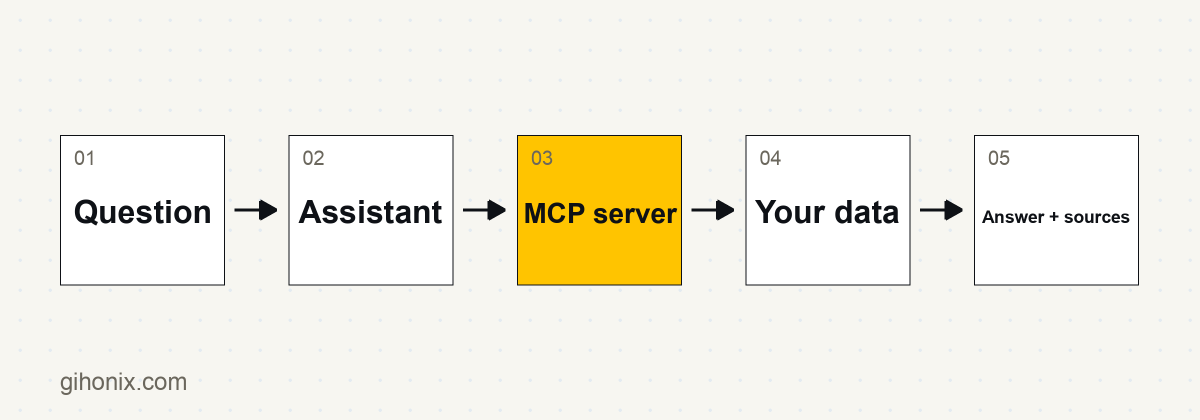
There are three parts:
- The assistant or application (the client). For example, a chat assistant a staff member uses.
- The MCP server. A small program that sits in front of one of your systems and describes what the assistant is allowed to ask for.
- Your system. The shop, CRM, database or document store behind it.
When you ask, "Where is order 1042?", the assistant sees that the server offers an order-lookup tool, asks the server to run it, receives the answer and replies to you in plain language. For a closer look at the server itself, read what an MCP server is.
What can an MCP server offer?
Servers can offer three building blocks: tools (actions the assistant can call), resources (content it can read) and prompts (reusable templates). They are explained with examples in MCP tools, resources and prompts.
What does it look like in a business?
- A support agent asks about a customer and sees their orders and tickets in one answer.
- A sales rep asks for a meeting brief from CRM records.
- An operations manager asks which jobs are behind schedule.
- A finance assistant lists overdue invoices.
See specific cases in MCP for e-commerce and MCP for CRM and sales data.
What MCP is not
- It is not an AI model. It does not make the assistant smarter or more accurate.
- It is not a product you simply switch on. Someone has to build or configure the server for your systems.
- It is not automatically safe. Safety depends on how access is limited.
- It does not replace your APIs. It usually sits on top of them; see MCP vs REST APIs vs function calling.
Is MCP safe?
It can be, when it is designed carefully: individual sign-in, narrow permissions, read-only access to begin with, human approval for risky actions and logging. The assistant should never have more access than the person using it. Details are in how to secure an MCP server.
What should a non-technical team ask first?
- Which one repeated question or task would we like help with?
- Where does the answer live today?
- Who may see that information?
- How will we check the assistant's answers?
- Who owns this after launch?
If you can answer those, you are ready for a planning conversation; our guide to planning an MCP server shows the next steps.
Is MCP here to stay?
MCP is an open standard with active development, and the specification changes over time. Check the official documentation for current details on versions and features, and choose a developer who tracks them.
Work with Gihonix
Gihonix is a software, AI and web development company based in Coimbatore, India, working with businesses locally, across India and worldwide. We plan and build servers through our MCP development service. Contact us for a plain conversation about whether MCP fits you.
Frequently asked questions
What does MCP stand for?
Model Context Protocol. It is an open standard for connecting AI assistants to tools and data.
Do I need MCP to use AI in my business?
No. Many useful AI tasks need no connection to your systems. MCP helps when an assistant needs controlled access to your data or tools.
Is MCP only for big companies or developers?
No. Developers build the servers, but the users are ordinary staff asking plain-language questions, and small businesses can benefit.
Who created MCP?
It was introduced by Anthropic as an open standard and is documented publicly at modelcontextprotocol.io. Check the site for its current governance and details.